
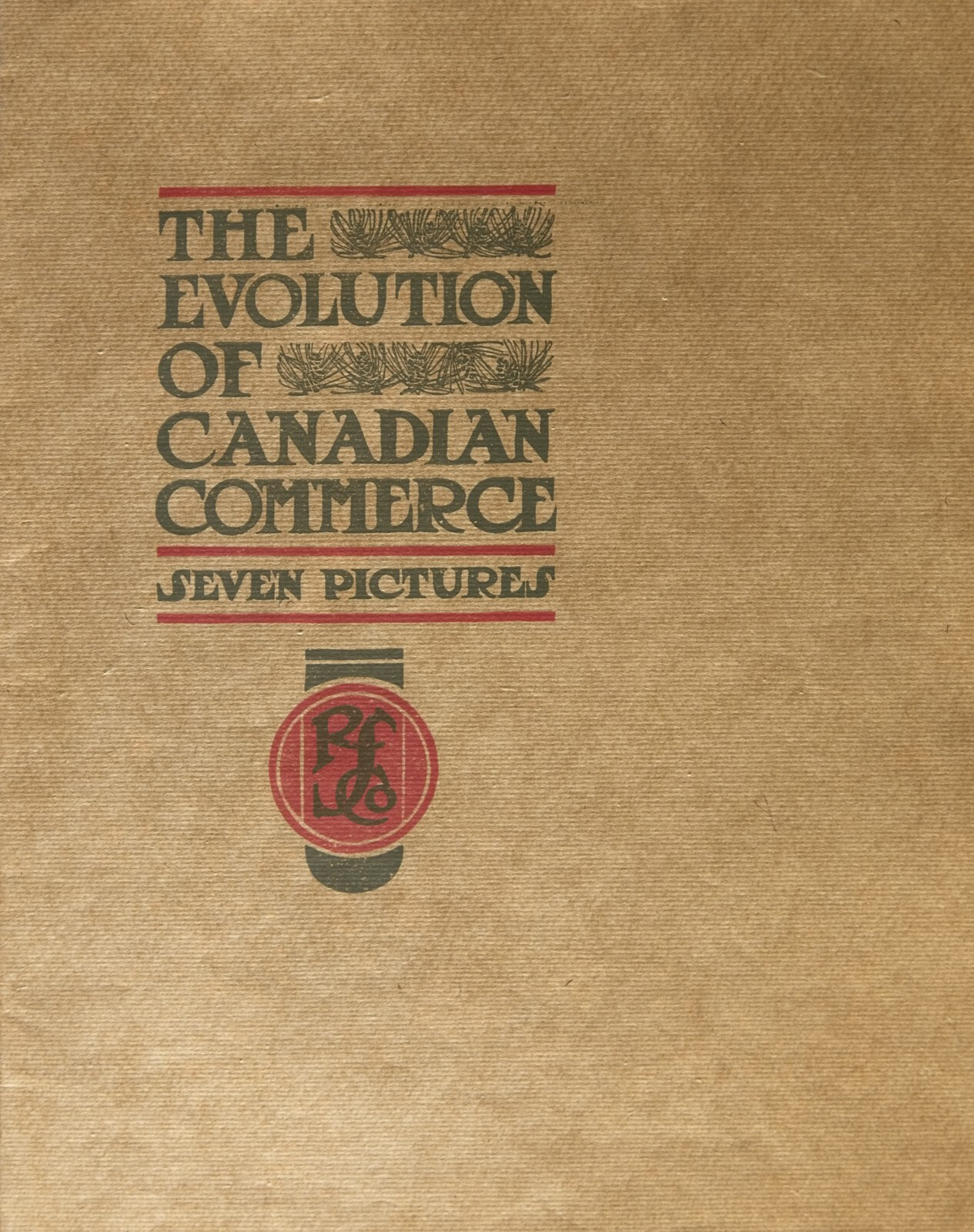
The Evolution of Canadian Commerce
Seven Drawing in Pen and Ink by C.W. Jefferys With Supplementary Text by S. H. Howard
Inside front cover
IN presenting this little book to the people of Canada as a Souvenir of its New Building, now practically complete—The Robert Simpson Company Limited, feels that no Canadian illustration of progress can be more graphic than its own — that of the Retail Store.
[ Logo featuring the intertwined initials: RSCLo within a circular crest ]
The Evolution of Canadian Commerce
Seven Drawings in Pen and Ink by C. W. Jefferys With Supplementary Text by S. H. Howard
[ Logo of The Robert Simpson Company featuring intertwined initials RSCLo within a circular crest ]
Published by order of The Robert Simpson Company, Limited, Toronto, Ontario, Canada August Thirtieth, Nineteen Hundred and Nine
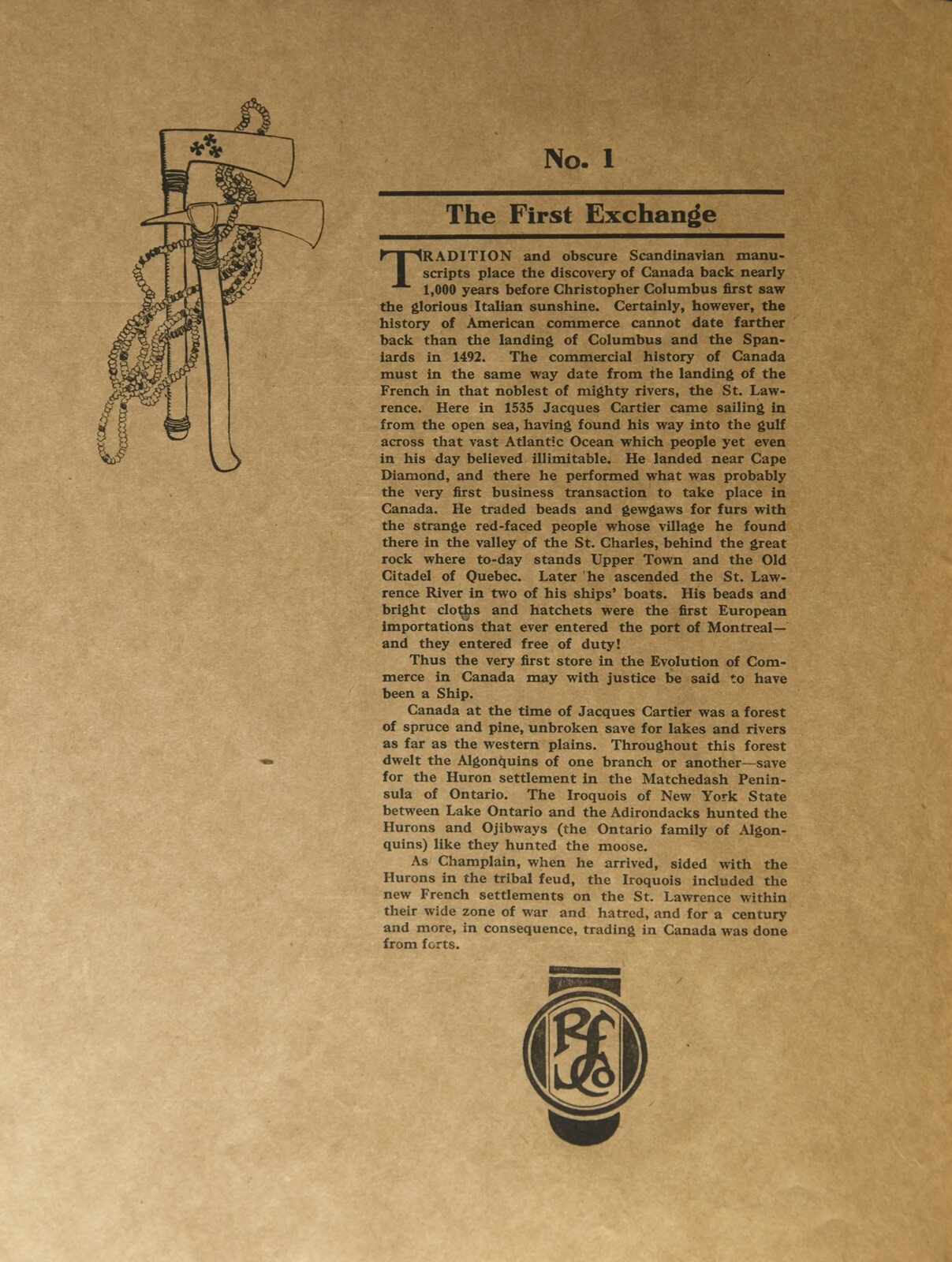
No.1 The First Exchange
TRADITION and obscure Scandinavian manuscripts place the discovery of Canada back nearly 1,000 years before Christopher Columbus first saw the glorious Italian sunshine. Certainly, however, the history of American commerce cannot date farther back than the landing of Columbus and the Spaniards in 1492. The commercial history of Canada must in the same way date from the landing of the French in that noblest of mighty rivers, the St. Lawrence. Here in 1535 Jacques Cartier came sailing in from the open sea, having found his way into the gulf across that vast Atlantic Ocean which people yet even in his day believed illimitable. He landed near Cape Diamond, and there he performed what was probably the very first business transaction to take place in Canada. He traded beads and gewgaws for furs with the strange red-faced people whose village he found there in the valley of the St. Charles, behind the great rock where to-day stands Upper Town and the Old Citadel of Quebec. Later he ascended the St. Lawrence River in two of his ships' boats. His beads and bright cloths and hatchets were the first European importations that ever entered the port of Montreal—and they entered free of duty!
Thus the very first store in the Evolution of Commerce in Canada may with justice be said to have been a Ship.
Canada at the time of Jacques Cartier was a forest of spruce and pine, unbroken save for lakes and rivers as far as the western plains. Throughout this forest dwelt the Algonquins of one branch or another save for the Huron settlement in the Matchedash Peninsula of Ontario. The Iroquois of New York State between Lake Ontario and the Adirondacks hunted the Hurons and Ojibways (the Ontario family of Algonquins) like they hunted the moose.
As Champlain, when he arrived, sided with the Hurons in the tribal feud, the Iroquois included the new French settlements on the St. Lawrence within their wide zone of war and hatred, and for a century and more, in consequence, trading in Canada was done from forts.
[ Logo of The Robert Simpson Company ]
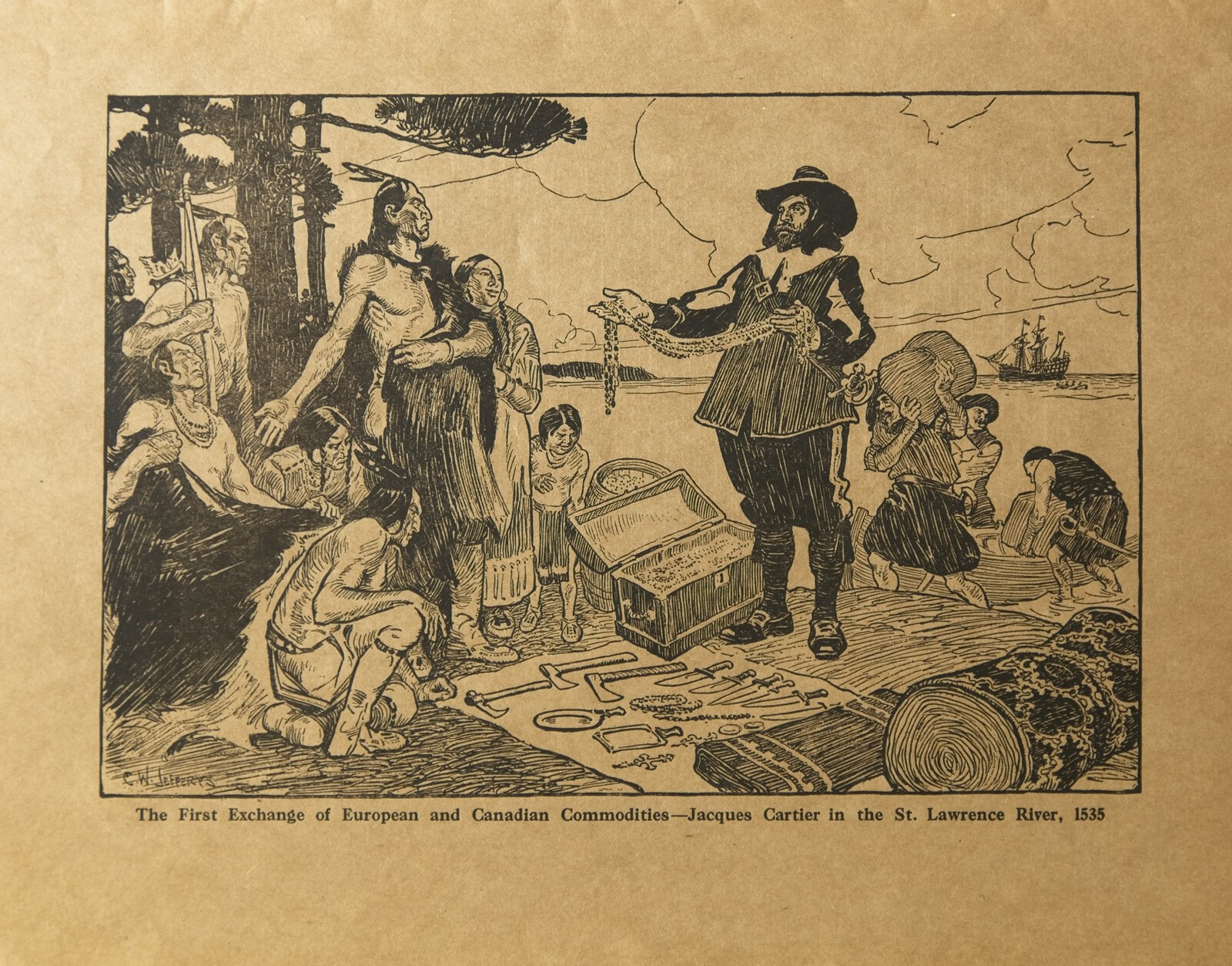
The First Exchange of European and Canadian Commodities - Jacques Cartier in the St. Lawrence River, 1535
No. 2 The Fortified Trading Post
JUST as Canada's first store was the discoverer's ship, so her next store was a Fort, and for many years the stockaded trading post continued as a type of the Canadian place of business. Quebec City itself was a fort; Montreal and Three Rivers were simply stockaded strongholds of trade.
Gradually these log strongholds spread across the continent. Soldiers of the French Army, aristocratic veterans of European wars, led the way into the wilderness, built these little fortified stores in the forest and, with them as points of vantage, mapped the inland waterways of half a continent. By the Ottawa they went, by the St. Lawrence and the Great Lakes, by any and all the rivers which opened roads into the vast unknown interior, adventured those hardy men in canoes of bark, seeking for fresh sites upon which to build their trading posts, seeking adventure, seeking a fortune in fur.
As far as the Rocky Mountains they set their stockades; as far as the headwaters of the Missouri, the mouth of the Mississippi, the headwaters of the Assinaboine, the Hudson's Bay; and in a later date, after the Conquest, the stockaded stores of the fur-traders reached the shores of the Pacific on the westernmost edge of the continent and the frozen Arctic on the northern extreme.
These stores were literally forts, with walls, bastions, guns and gates. Trading for safety's sake took place outside the stockades. A brave, adventurous business, in which force and courage took the place of law, and men made fortunes or wrecked their lives as it chanced.
To-day cities spread where those log forts of trade once stood; cities whose names alone preserve the old traditions of the Fur Trade—Toronto, Detroit, Sault Ste. Marie, Fort William, Duluth, Winnipeg, Portage la Prairie, St. Louis, New Orleans, Vancouver, and them all. Midway, linking those wild times with to-day, still sits Fort Edmonton in a bend of the great North Saskatchewan, even yet a depot of the old-time Canadian staple which once was all in all—Fur.
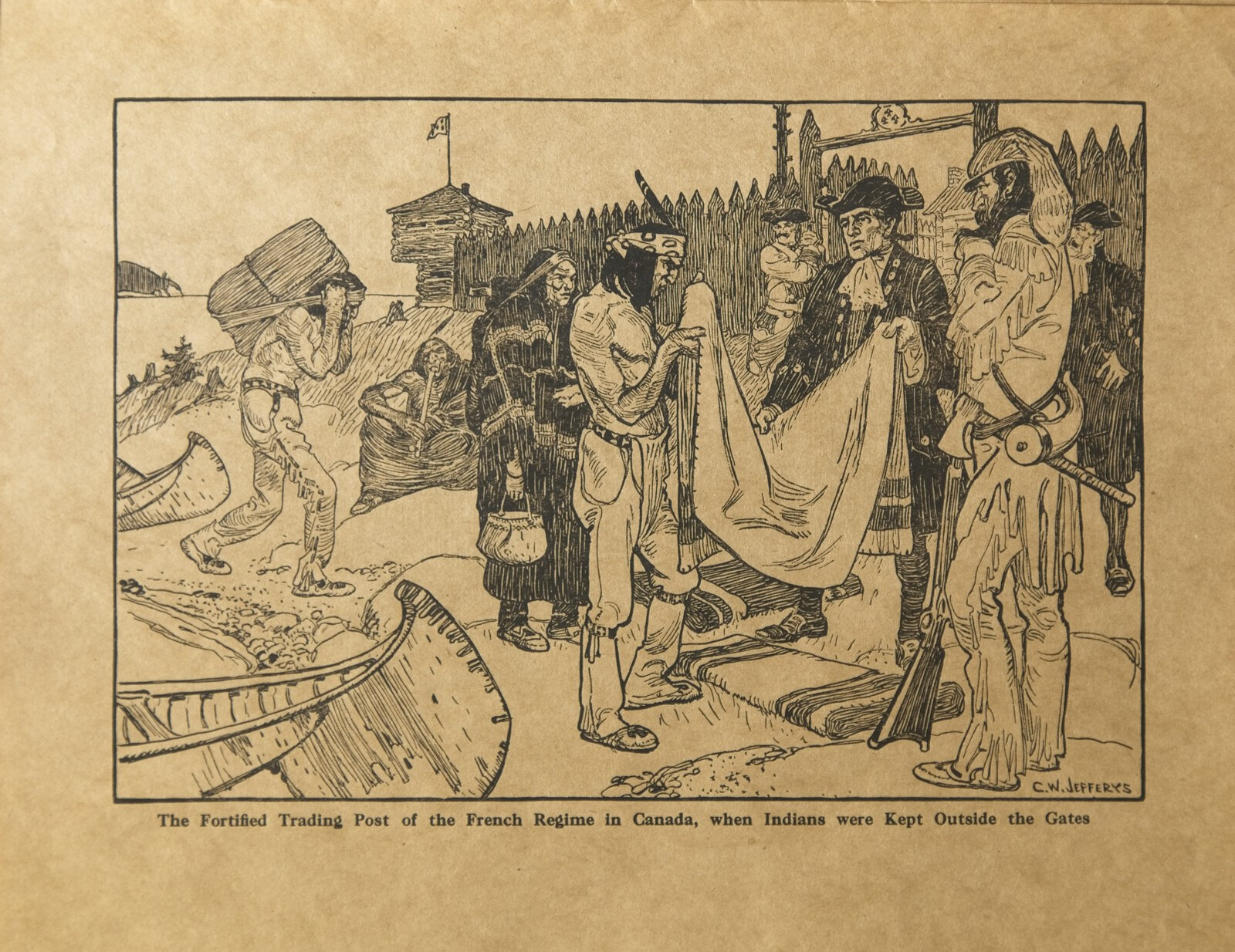
The Fortified Trading Post of the French Regime in Canada, when Indians were Kept Outside the Gates
No. 3 When Fur was All in All
FOR two hundred and fifty years after Jacques Cartier ascended the St. Lawrence Canada's important contribution to the world's wealth consisted entirely of Fur. For sake of Beaver skins and Freedom, and contrary to laws and prayers, men forsook civilization and relapsed, singing, into savagery—men, many of them born to the refinements of the most luxurious period in the history of luxury-loving France.
Some of these wild Coureurs des Bois it was who built the first stores in Upper Canada—mere huts of round, unbarked logs, set on the shore of a lake. Once a year, perhaps, these free-trading Coureurs des Bois came to Montreal to sell a canoe load of furs and to swagger in barbaric holiday finery.
Never again on this continent will such a picture of contrast live and move as the streets of Montreal presented at the season when the Fur Canoes came down—Ladies in silks and satins, Bush-runners in buckskin and beads, Town Gentlemen in gorgeous doublets and cloaks of European fashion, Farmers, Tradesmen and Mechanics in the peasant and bourgeois costumes of Normandy; Soldiers in blue and scarlet, Indians naked of limb and cloaked in trade blankets or the skins of wild animals. From Montreal again would set out the great freight canoes for the big licensed Companies, toiling in the far North-west, laden to the gunwales with guns, powder, shot, knives, axes, beads, blankets, and brandy, manned by half-wild Voyageurs, under a Commander who had probably served half his life as an army officer of France. And by stealth—for free-trading was for long illegal—would set forth again singly, or by twos and threes, the smaller canoes of the reckless Coureurs des Bois. Fur was the universal quest—beaver, otter, mink, fox, wolf, lynx, martin, fisher, buffalo, and the all-pervading muskrat.
And thus to the Conquest of Canada by the English, and practically thus long, long after the Conquest, when Yankee, British and European free-traders shared the spoils, and Scotchmen re-organized the trade of the great North-west. To-day, on the errands of the Fur Trade, there are men still living who have journeyed from Montreal to Vancouver by birch-bark canoe.
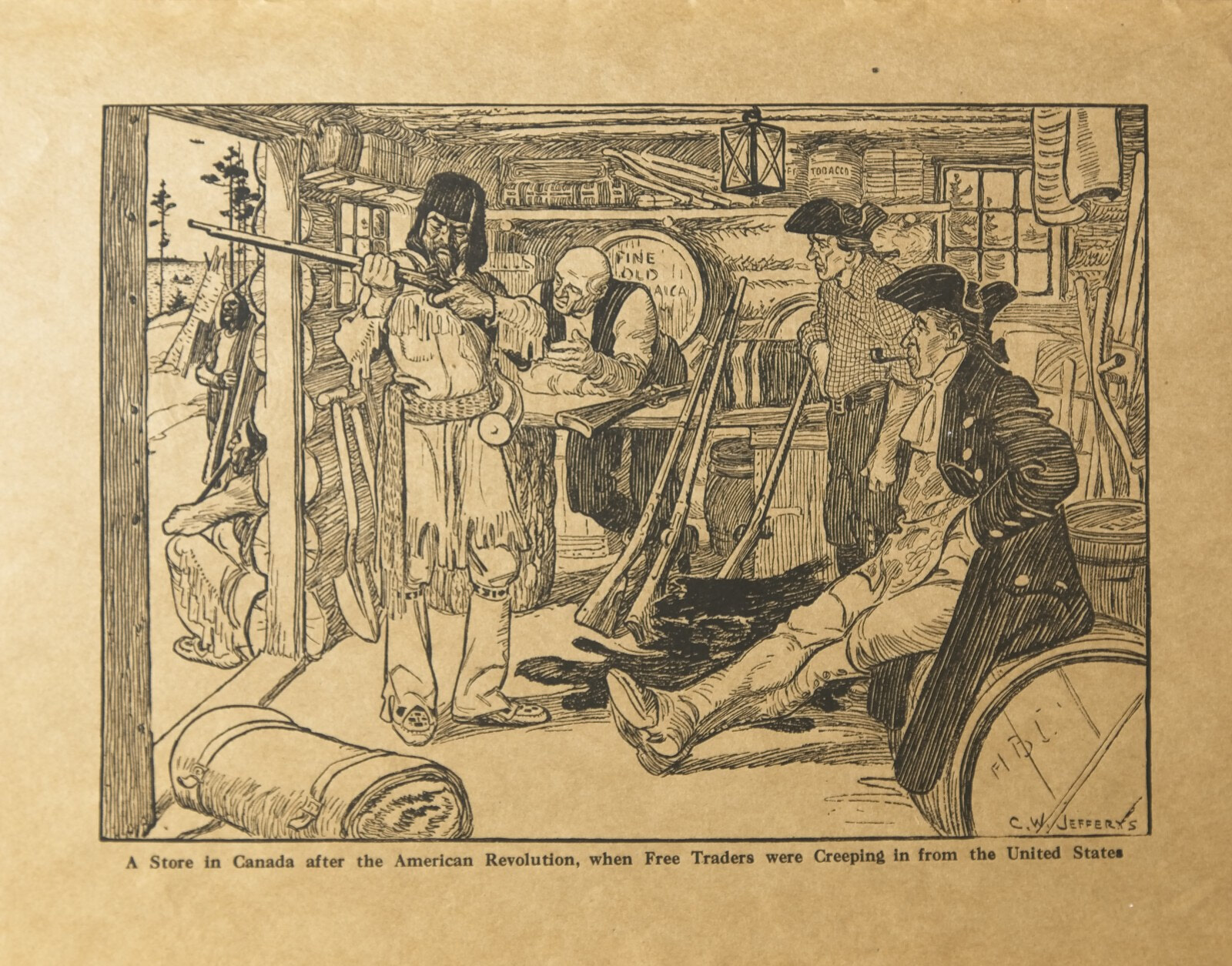
A Store in Canada after the American Revolution, when Free Traders were Creeping in from the United States
No. 4 The Square Timber Store
BEFORE the American Revolution Canada consisted of a fur preserve and an agricultural fringe on the banks of the lower St. Lawrence. The war with the trees had hardly begun. But with the advent of the United Empire Loyalists came the invasion of the American Ax. The forest war began in desperate fury, and the spirit of it has scarcely cooled to this day.
With the Settler came the settler's kind of Store, a store where women traded eggs for calico, where men bought bear-traps and plough-shares, and paid for them with coon skins; a store for all the rough, strong goods used and worn in the stump fields and in the forest, the tools of woodsmen and the implements of backwoods farmers. Those were the days when Old Ontario was cleared; when the great oaks, elms, pines and walnuts were laid up in heaps at the "logging bees" and burned; when the first wheat was sown amid the stumps and reaped later with a sickle, carried to the mill, two days' journey on horse-back—or a week's journey, it might be, on a man's own shoulders—to be ground into flour and carried home again for baking in the great outdoor ovens.
Those were the days when women made soft soap from wood-ashes, of which there were plenty; when wild pigeons flew in countless flocks that darkened the sun; when wolves howled around the barn of winter nights, and in the spring, before the sucker-run commenced in the creek, black bears, emerging hungry from their dens, broke into pig sties. The store was apt to be a structure of squared timbers, oblong as a box; strong, neat, whitewashed and business-like.
The lumber trade had commenced by now, and great logs were squared in the winter-time, hauled to the water, made up into rafts, and the French-Canadian raftsmen rowed and sailed them down to the English timber ships in the coves at Quebec.
Oxen were the beasts of heaviest burden, but men and women put themselves under a yoke scarcely lighter, and toiled as we in these days of machinery and prairie sod can scarcely hope to understand, that in place of Forest their children might inherit Fields.
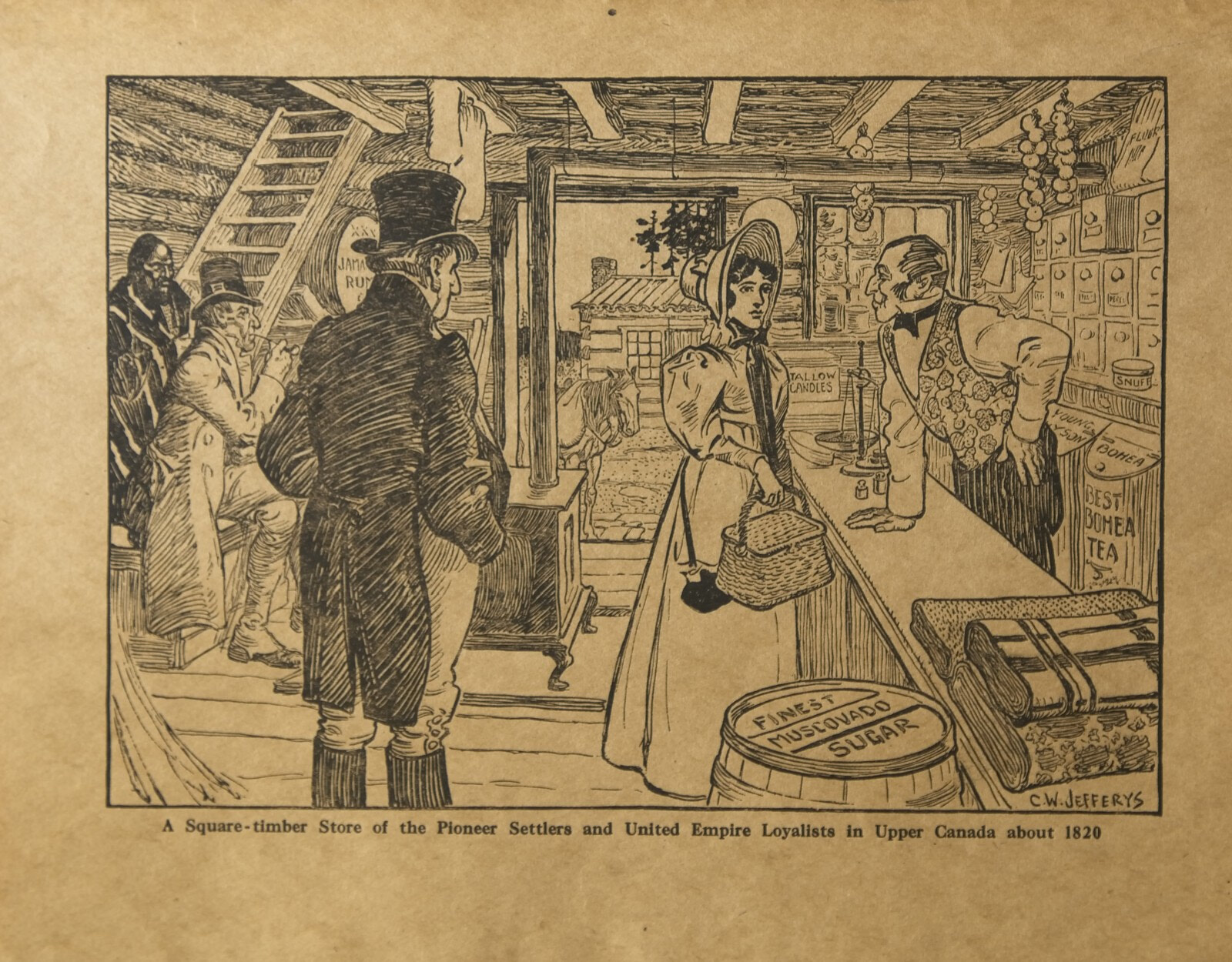
A Square-timber Store of the Pioneer Settlers and United Empire Loyalists in Upper Canada about 1820

No. 5 The Clap-Board Store
THE circular-saw mill produced a great change in the architecture of Old Ontario. Log dwellings were abandoned to the chickens, and the folks all moved into board houses painted outside and plastered within. And, of course, the Stores were first in this matter, as befitted the most active business element in each little community. So the square-timber store became an out-house for the storage of salt and bulky produce, or was made over into a kitchen and permitted to protrude from behind the new clap-boarded up-to-date structure. The post-office occupied a desk behind the counter, with a high wooden grill balustrade to make it impregnably official. In the centre of the floor stood the big box-stove. Here the statesmen of the township gathered on Saturday nights, while the women folks traded in their butter, asked for their mail, if any, and kept the old farm-horse waiting in the cold, to exchange live news and life-long convictions.
The corner store was the secular centre of society, just as the church was the spiritual centre. Here all human interest focussed. Here all news that was real, and not merely impersonal—local information about people that people knew—was broken to the public and published to the world. Here also the doings of the Government at York, afterwards Toronto, were discussed. In the old clap-board store at the corner, Honorable Alexander Mackenzie and Sir John A. Macdonald received their just dues, and perhaps a little more.
And to-day, 42 years since Confederation, it stands in a hundred surviving instances still—the “Store at the Corners” of two hundred different Old Ontario roads. It has lost a deal of paint in the course of the years, and the old clap-boards have a curl in them, maybe. Perhaps an agricultural machine agency has taken the building for a warehouse, and it is not a real corner store any more, but most people remember when it was, and a good one, too, with a human interest such as is the envy of many a big store of to-day. Tempus Fugit. The old order changeth.
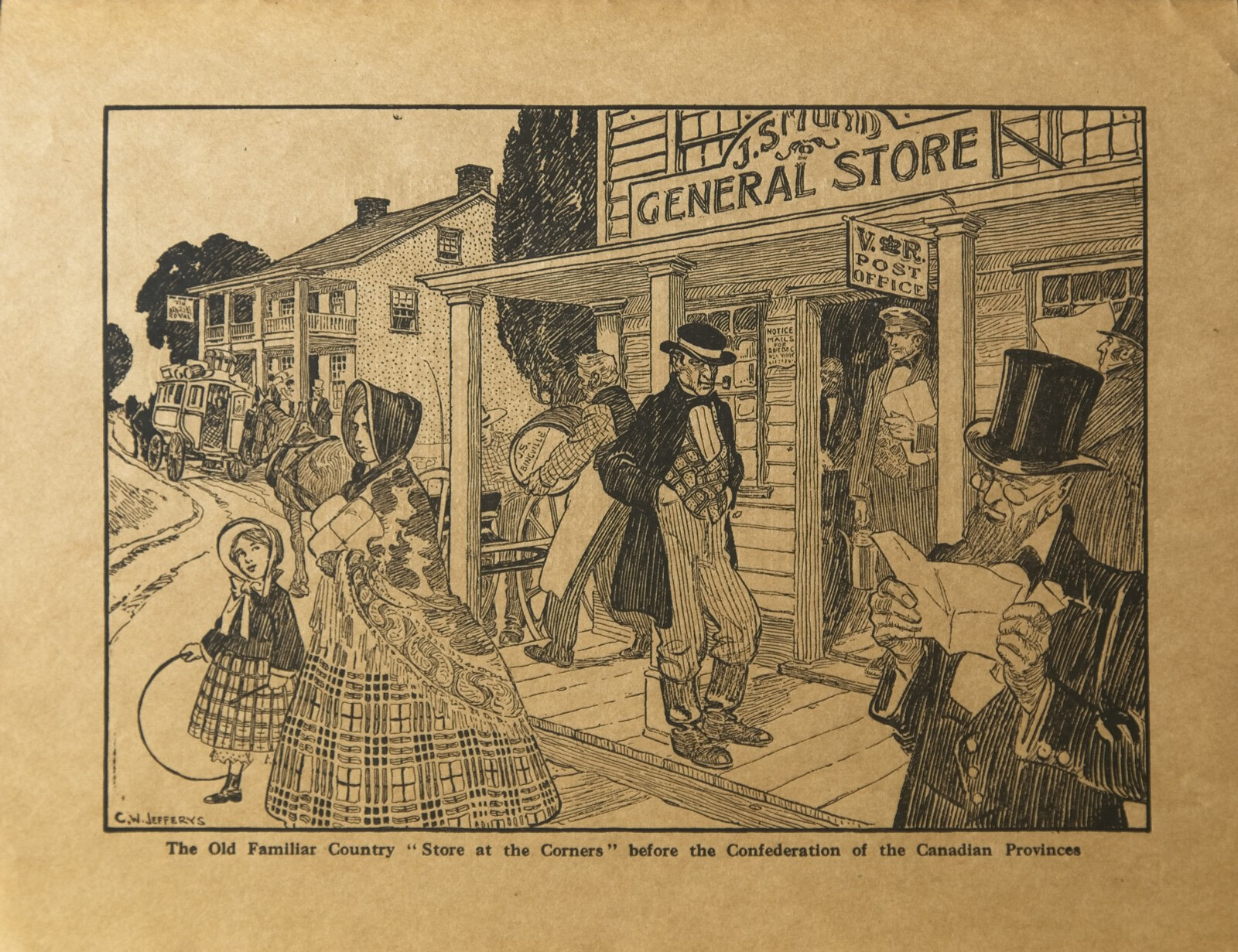
The Old Familiar Country "Store at the Corners" before the Confederation of the Canadian Provinces
No. 6 The Era of the Red Brick
"MUDDY York" became Toronto in due course of time, but the clay which gave York its reputation, though subdued, still lurked beneath the surface, despite the revival of the ancient Indian name, and the passing of the insultingly descriptive sobriquet used more or less during the interval.
Toronto clay being on the spot and very suitable, brickmaking naturally suggested itself, and the clap-board period was overlapped by the era of soft red Brick.
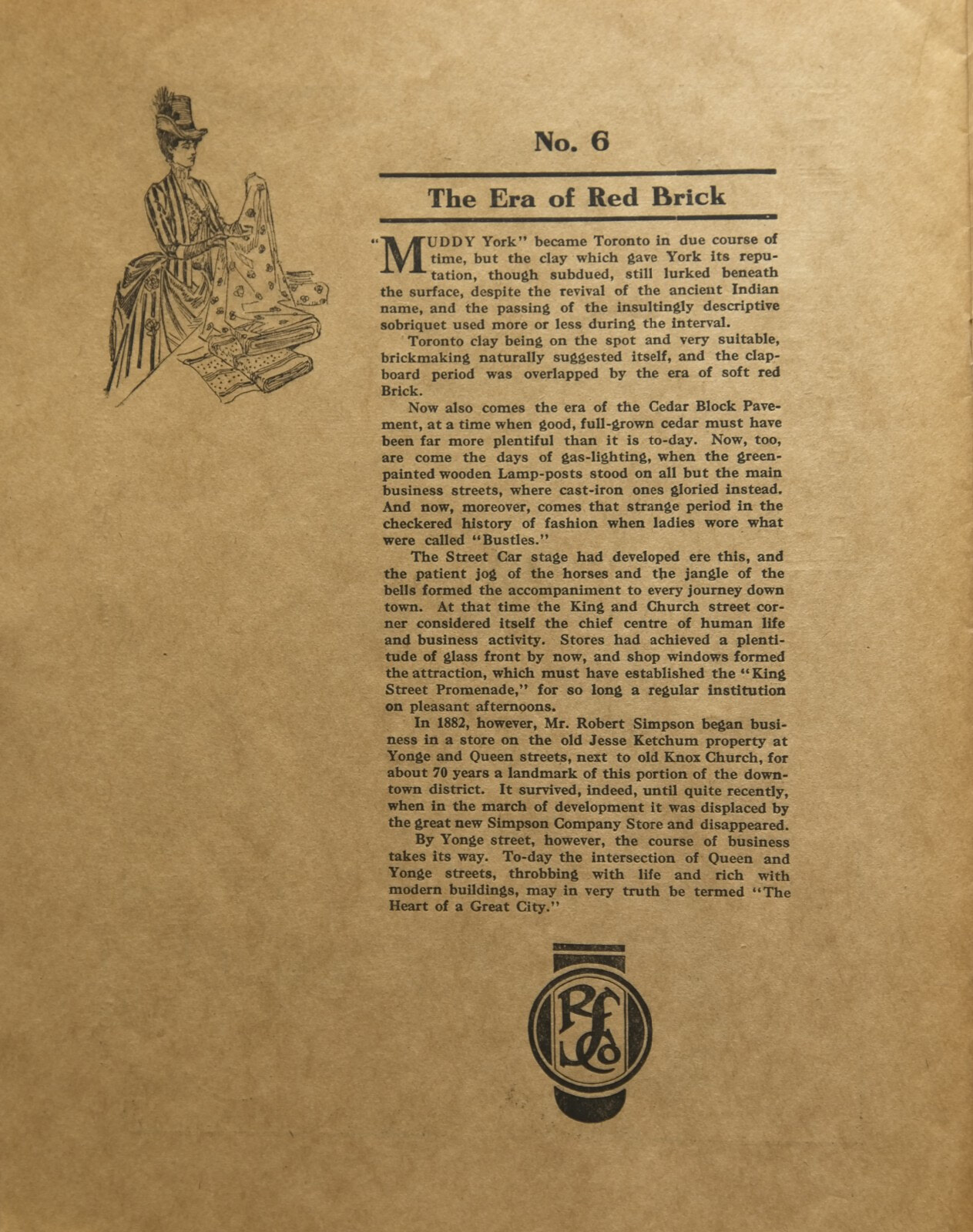
Now also comes the era of the Cedar Block Pavement, at a time when good, full-grown cedar must have been far more plentiful than it is to-day. Now, too, are come the days of gas-lighting, when the green-painted wooden Lamp-posts stood on all but the main business streets, where cast-iron ones gloried instead. And now, moreover, comes that strange period in the checkered history of fashion when ladies wore what were called "Bustles."
The Street Car stage had developed ere this, and the patient jog of the horses and the jangle of the bells formed the accompaniment to every journey down town. At that time the King and Church street corner considered itself the chief centre of human life and business activity. Stores had achieved a plentitude of glass front by now, and shop windows formed the attraction, which must have established the "King Street Promenade," for so long a regular institution on pleasant afternoons.
In 1882, however, Mr. Robert Simpson began business in a store on the old Jesse Ketchum property at Yonge and Queen streets, next to old Knox Church, for about 70 years a landmark of this portion of the down-town district. It survived, indeed, until quite recently, when in the march of development it was displaced by the great new Simpson Company Store and disappeared.
By Yonge street, however, the course of business takes its way. To-day the intersection of Queen and Yonge streets, throbbing with life and rich with modern buildings, may in very truth be termed "The Heart of a Great City."
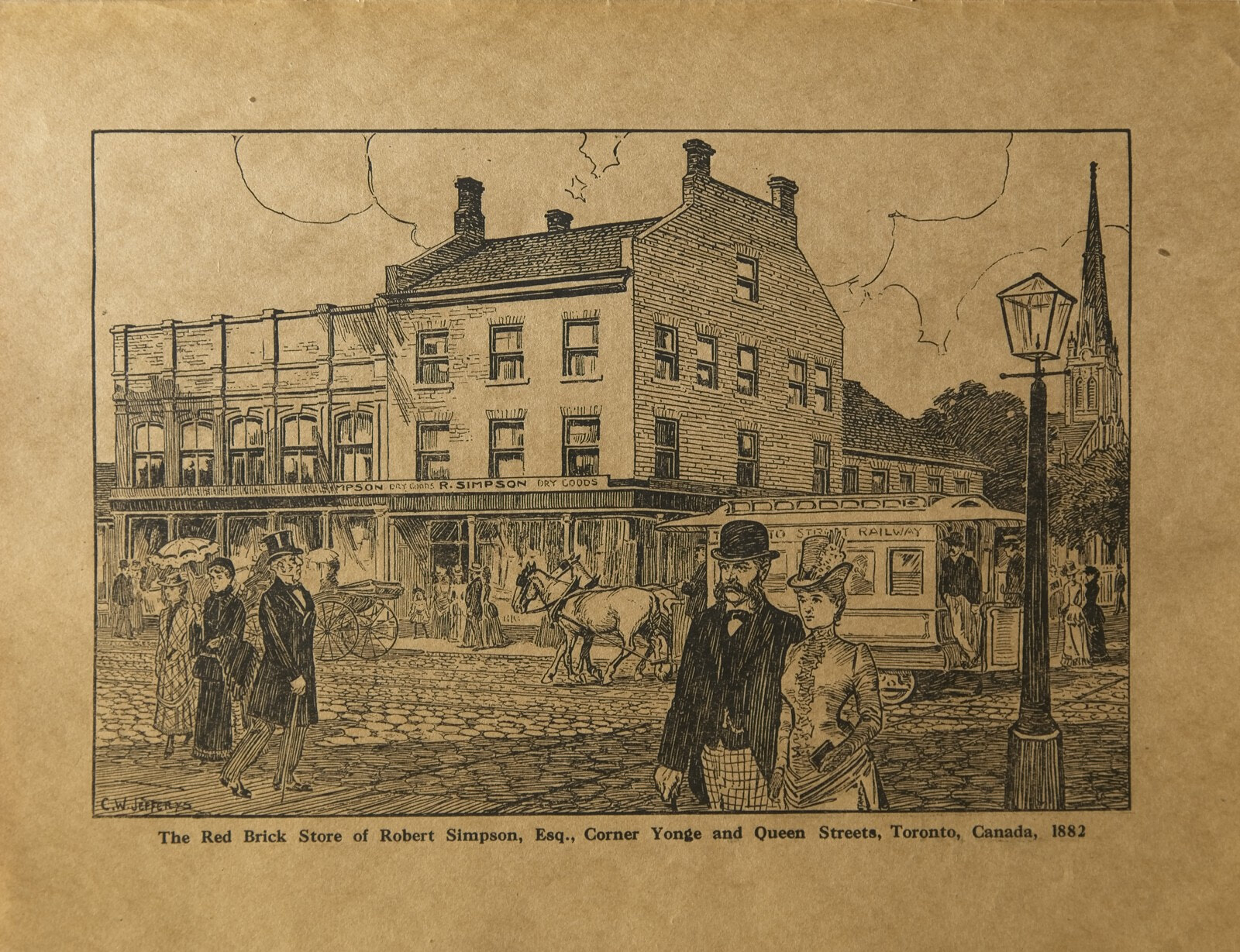
The Red Brick Store of Robert Simpson, Esq., Corner Yonge and Queen Streets, Toronto, Canada, 1882

No. 7 In the Age of Steel
WHEN the first log store was built upon the site of Toronto men wore moccasins and women draped themselves in blankets. To-day in Toronto the new fashions of Paris rule almost from the first day they are born. The produce of practically every country on the face of the globe gathers into cars and ships addressed "Toronto".
When in Canada men travelled by snowshoes and canoes, stage coaches and sedan chairs conveyed travellers in Europe. To-day, the electric railway of Toronto compares with any street tramway in civilization. Steam railroads span the continent; modern trains are sped to serve the queenly city's needs. Horses and vehicles of all descriptions throng the streets. Automobiles flash by on asphalt. Bicycles criss-cross and wriggle through the press of traffic. The other day an air-ship circled the city hall tower and passed high above the crowding roofs.
When on the site of Toronto men traded in log stores, brick and mortar housed the commerce of Europe. To-day, in the age of steel, a Store in the heart of Canada ranks as the largest building of steel-frame construction in the British Empire. Bounded by four streets—Yonge, Queen, James and Richmond—it is a complete cage-block of rolled-steel girders and beams, swathed in terra cotta and concrete, faced with Roman brick and chiselled masonry. Its seven floors contain over eleven acres. Its roof shelters a trade of dollars counted in millions. Its stock includes practically all the personal and domestic needs and luxuries of civilized humanity.
Modern, brilliant, flashing with sunlight or electricity, tier upon tier of living windows, keen as though with perception, stands this great creation of steel and terra cotta in the heart of a beautiful city. About it surges the life and business of a third of a million men, women and children—people with the complexed wants of developed society open-eyed, alert, front-ranked in the march of the world. Civilization, seed of Jacques Cartier, has blossomed in this the yester limit of known lands.
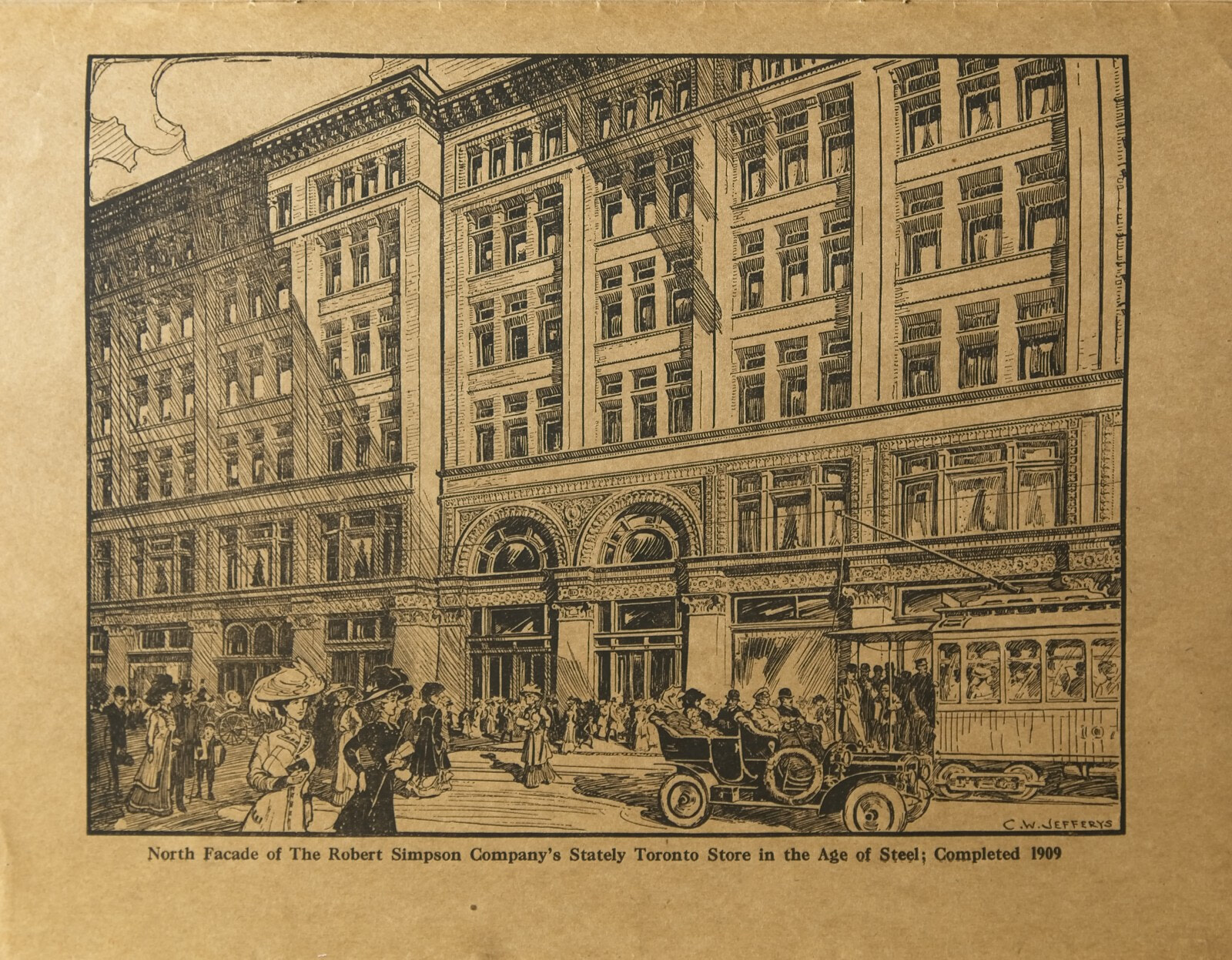
North Facade of The Robert Simpson Company's Stately Toronto Store in the Age of Steel; Completed 1909

Inside back cover

Back Cover

Envelope containing all pages
The Evolution of Canadian Commerce
1909
Lithographs on brown paper
Provenance
Estate of the artist
Orval and Barbara Jefferys Allen, Deville, Alberta
Anthony and Nancy Allen, Edmonton, Alberta
Exhibited
Publication References
- “The evolution of Canadian commerce – seven pictures.” In The Globe, August 30, 1909, p. 5. Illus.
“No. 1—The First Exchange of European and Canadian Commodities— Jacques Cartier on the St. Lawrence River, 1535.”
- “The evolution of Canadian commerce –seven pictures.” In The Globe, August 31, 1909, p. 5. Illus.
“No. 2—A Fortified Trading Post of the French Regime in Canada when the Indians were kept outside the gates.”
- “The evolution of Canadian commerce – seven pictures.” In The Globe, September 1, 1909, p. 5. Illus.
“No. 3—A Store in Canada after the American Revolution when Free Traders were creeping in from the United States.”
- “The evolution of Canadian commerce—seven pictures.” In The Globe, September 2, 1909, p. 5. Illus.
“No. 4—A Square-timber Store of the Pioneer Settlers and United Empire Loyalists in Upper Canada about 1820.”
- “The evolution of Canadian commerce—seven pictures.” In The Globe, September 3, 1909, p. 5. Illus.
“No. 5—The Old Familiar Country ‘Store at the Corners’ Before the Confederation of the Canadian Provinces.”
- “The evolution of Canadian commerce--seven pictures.” In The Globe, September 4, 1909, p. 3. Illus.
“No. 6—The Red Brick Store of Robert Simpson, Esq., Corner Yonge and Queen Streets, Toronto, Canada, 1882.”
- “The evolution of Canadian commerce—seven pictures. In The Globe, September 6, 1909, p. 1. Illus.
“No. 7—North Façade of the Robert Simpson Company’s Stately Toronto Store in the Age of Steel, Practically Complete, 1909.”
- “A fine bit of work.” In Toronto Star, Aug. 31, 1909, p. 6.
“There has been prepared for free distribution at the Canadian National Exhibition a booklet or portfolio of seven pictures showing ‘The Evolution of Canadian Commerce’. The pictures are from drawings especially prepared by Mr. C.W. Jefferys’ [sic] the well-known artist, and the letterpress is by Mr. S.A. Howard… The whole thing has been carried out in a way so artistic that it ranks high, apart from, or, if you like, notwithstanding, its advertising character…The artistic and literary qualities of the booklet give it value: it was a work that needing doing by just such men as Messrs. Jefferys and Howard…”
-
“Evolution of Canadian Trade.” In The Globe, August 31, 1909, p. 2.“The story of the great trade growth of the Dominion is mainly told in a series of pen and ink drawings by the well-known artist, Mr C.W. Jeffreys [sic], which possess all the excellent characteristics of that gentleman’s work.”
- “The seven stages of the store.” In The Canadian Courier, Vol. VI, No. 15, September 11, 1909, p. 22. [“store” refers to Robert Simpson Co.]
“Recently two clever young men of Toronto have conspired to write and to picture the seven stages in the evolution of trade in Canada. The two makers of the handsome booklet [The evolution of Canadian commerce] containing the pictures and short stories are Mr. C.W. Jefferys, the well-known black and white artist—and occasional painter of oils and water-colours—and Mr. Sid H. Howard, advertising manager for the Robert Simpson Company…”
Remarks
Related


Found one of these booklets in my father’s things after his death. Love that the drawings are printed on brown craft paper.
Comments