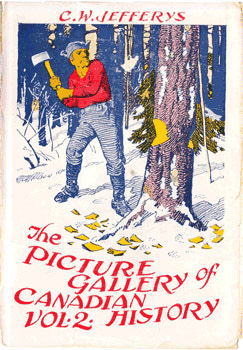
The Picture Gallery of Canadian History Vol. II
Jefferys, Charles W. The Picture Gallery of Canadian History Vol. II
Toronto, Ryerson, 1945. 260 p. Illus.
The Picture Gallery of Canadian History Vol. 2
Title: The Picture Gallery of Canadian History Vol. 2
Author: C. W. Jefferys
Publisher: Toronto, Ryerson, 1945. 271 p. Illus.
Buy a copy online at AbeBooks
Table of Contents
References
- Dr C. W. Jefferys was one of Canada's foremost historical artists and his three-volume Picture Gallery of Canadian History is probably his best-known achievement. His hundreds of carefully researched pictures of artefacts, people, places and episodes from Canadian history provide a "treasure house of information about this country's past" (Toronto Star).
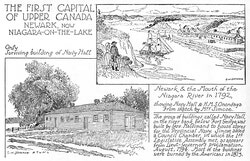
Newark and the mouth of Niagara River, from sketch by Mrs. Simcoe
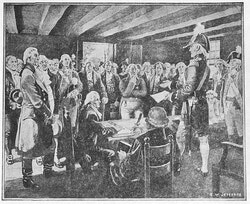
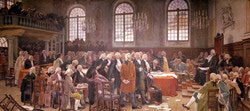
Charles Huot, the painter of the picture here reproduced, was born in Quebec in 1855, worked in Europe from 1874 until 1886, when he returned to Canada. He lived for several years at Sillery, where he died in 1930.
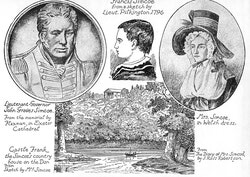
In the spring of 1794 Simcoe built a summer residence in the woods on the high ground overlooking the River Don, north of the town of York, just beyond the present St. James Cemetery.
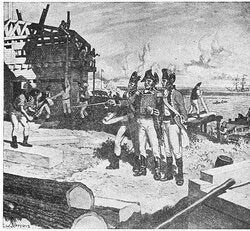
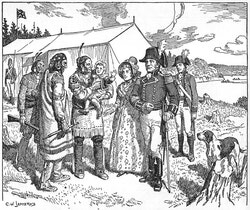
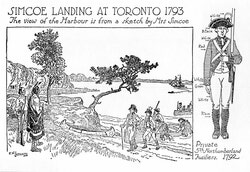
Mrs. Simcoe's Diary says, There was a party of Ojibway Indians here, who appeared much pleased with the firing. —a salute of 21 guns to celebrate the occasion. One of them took Francis in his arms...
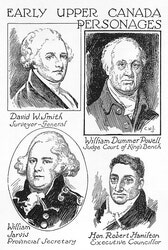
Note that the costumes and hair-dressing of Smith and Jarvis are of an earlier date than those of Powell and Hamilton: the former wear wigs, the latter their own hair.
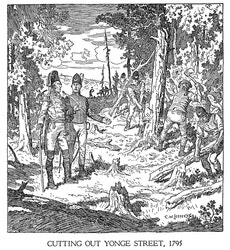
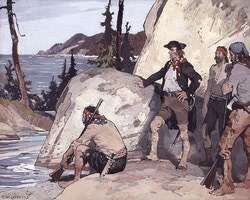
Mackenzie in his Journey speaks of having a hanger, a short sword, convenient for traveling in rough country, similar to that carried by Wolfe, as shown in the drawing in Vol. I, p. 242, depicting him at the Battle of the Plains.
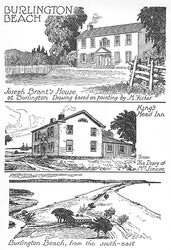
Joseph Brant's House at Burlington. Drawing based on painting by M. Fisher, King's Head Inn. From The Diary of Mrs. Simcoe. Burlington Beach, from the south-east.
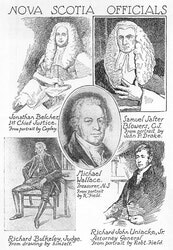
Robert Field, born Gloucester, England, about 1770. Came to America about 1792, and worked in New York, Philadelphia, Washington and Boston until 1808, when he settled in Halifax until his death in 1819.
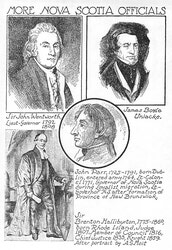
Albert Gallatin Hoit, or Hoyt (1809-1856), born in New Hampshire, worked for a time in Boston. He visited Saint John, N.B., and later, about 1840, Halifax...
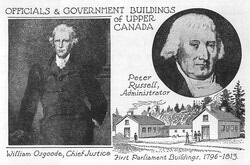
The first Legislative Buildings in York were situated at the lower end of the present Berkeley Street. They were burned by the Americans during the occupancy of York in April, 1813.
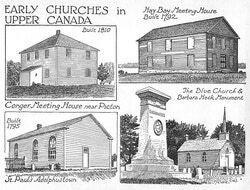
Conger Meeting House, 1810, St. Paul's Adolphustown, 1795, Hay Bay Meeting House, 1792
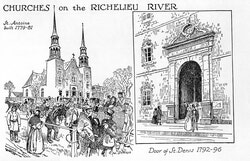
Most of the early Quebec churches existing today were built during the period from about 1770 to 1825.
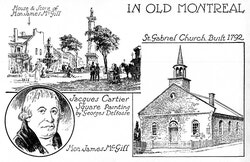
The corner stone of the Nelson monument was laid in 1809. Near it was the pillory where criminals were exposed with a label on their breasts stating the nature of their offence.
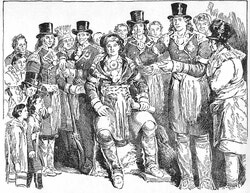
This picture is copied from a lithograph by H. Linch, after a painting by H. D. Thielcke. It shows the official or gala costume worn by Canadian Indian chiefs about 1796.