The Picture Gallery of Canadian History Vol. II
Jefferys, Charles W. The Picture Gallery of Canadian History Vol. II
Toronto, Ryerson, 1945. 260 p. Illus.
The Picture Gallery of Canadian History Vol. 2
Title: The Picture Gallery of Canadian History Vol. 2
Author: C. W. Jefferys
Publisher: Toronto, Ryerson, 1945. 271 p. Illus.
Buy a copy online at AbeBooks
Table of Contents
References
- Dr C. W. Jefferys was one of Canada's foremost historical artists and his three-volume Picture Gallery of Canadian History is probably his best-known achievement. His hundreds of carefully researched pictures of artefacts, people, places and episodes from Canadian history provide a "treasure house of information about this country's past" (Toronto Star).
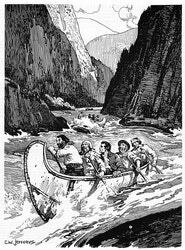
SIMON FRASER (1776-1862). Canadian fur trader and explorer. Simon Fraser exploring the river bearing his name in present-day British Columbia, Canada, in 1808.
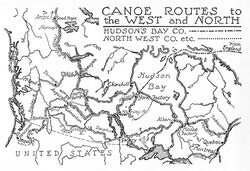
In the earliest years of British rule the merchants of Montreal began to engage in the fur trade and to equip expeditions to the north and west. The route usually followed was by the Ottawa River and the upper great lakes to Grand Portage...
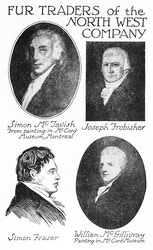
Simon McTavish, Joseph Frobisher, William McGillivray, Simon Fraser .
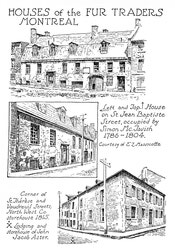
Simon McTavish s house on St.Jean Baptiste Street, Montreal, lodging and storehouse of John Jacob Astor, St.Therese and Vaudreuil Street
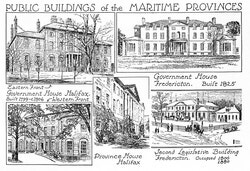
The present Government House is the third building erected for that purpose in Halifax. Its story is told in two brochures published by the Archives of Nova Scotia: Government House, and The Romance of Government House, by J. S. Martell...
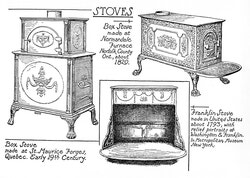
Stoves of some kind were in use in Canada much earlier than is commonly supposed. There is mention of them during the French period. Mrs. Simcoe, in her Diary, says that grates...
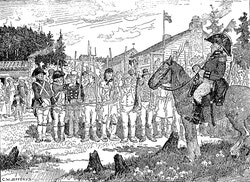
All able-bodied men were enrolled in the Canadian militia.They received occasional training in drill during the year, but the principal muster was on the birthday of King George III, June 4th.
The Picture Gallery of Canadian History Vol. 2 (Notes on Part Two)
NOTES ON PART TWO
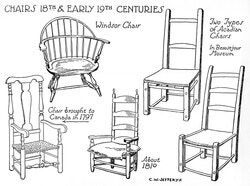
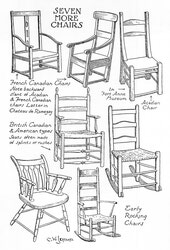
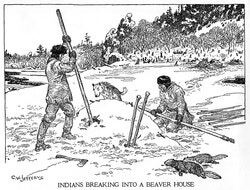
Before the introduction of steel traps, the Indians caught the beaver by piercing a hole in the roof of the house with an icechisel, set into a heavy six-foot pole, after barring the underwater outlet with stakes driven through the ice.
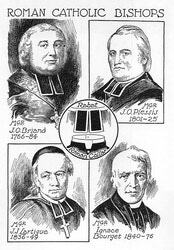
The Catholic clergy in Canada, during the French regime and until about 1860-1875, wore a sort of tab beneath the chin, called a Rabat. This was a piece of black cloth or silk, divided into two oblong parts, edged with white.
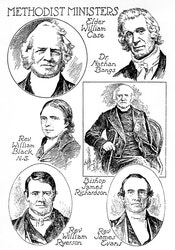
William Black, 1760-1834, the father of Methodism in Nova Scotia, was born in Yorkshire, and came to Nova Scotia with his parents in 1775. He became a preacher...
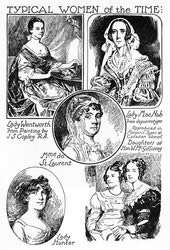
Frances Deering, born Boston, Mass., married 1769, John Wentworth (later knighted), Governor of New Hampshire, and Surveyor-General of the King s Woods in North America, two weeks after the death of her first husband.
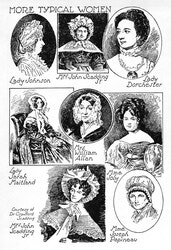
These pages have been designed to illustrate not only characteristic women of the time, but also to show styles of hairdressing and costume.
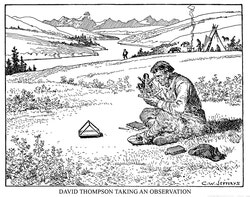
Thompson is using an artificial horizon. This is a flat iron pan into which mercury was poured. The pan is covered by a sloping glass roof, and placed on perfectly level and firm ground or rock in a situation to reflect the image of the sun.
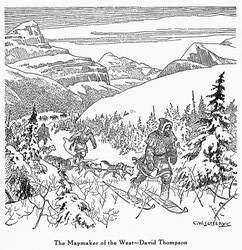
It is impossible in a brief sketch to give more than a bare outline of his career; but he has left the record of his life-work not only on the map of Canada and in his field notes, but also in the narrative of his travels which he wrote late in life.
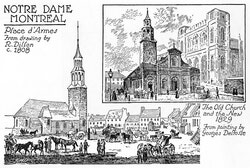
Richard Dillon was the proprietor of a hotel on the south-west corner of St. James Street and the Place d Armes in Montreal. It was very popular from about 1790 to 1815.
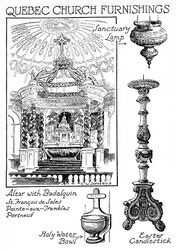
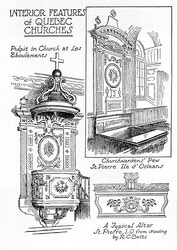
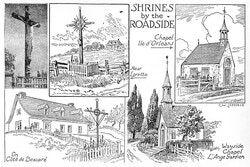
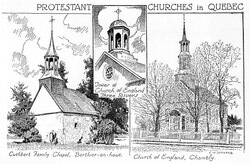
Most of the early Protestant churches in Lower Canada were built in the same style as the Catholic churches of the period: the classical or late Renaissance, with some trace of the influence of Wren and Gibbs, the English architects, whose work...